
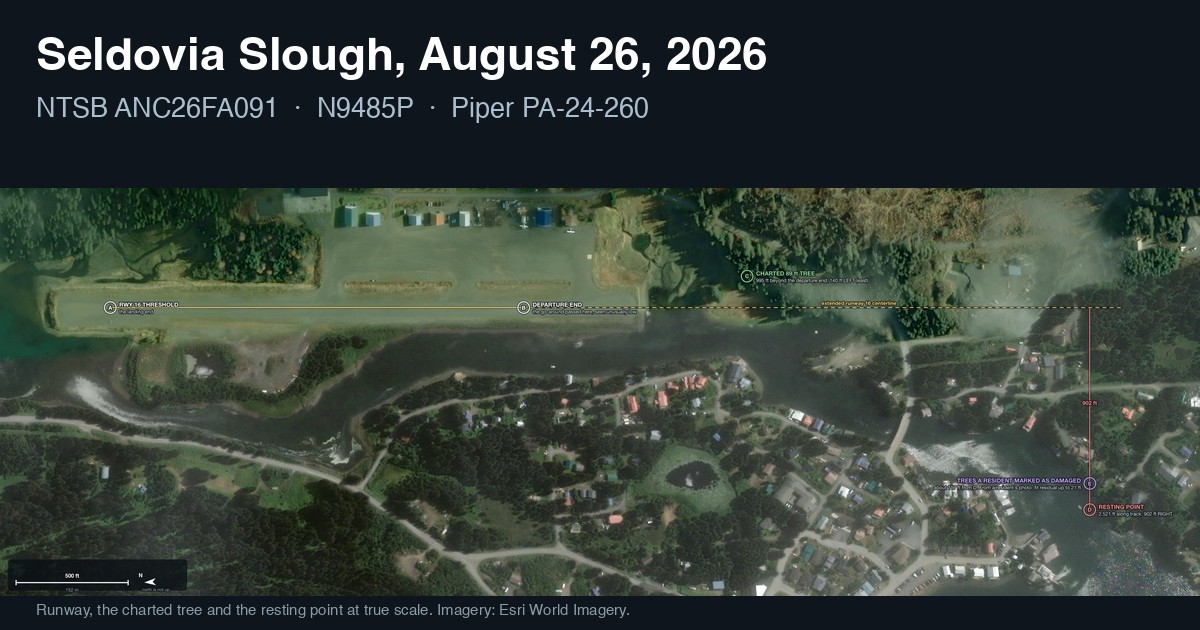
NTSB accident ANC26FA091 is the crash of N9485P, a Piper PA-24-260 Comanche, into Seldovia Slough beside Seldovia Airport, Alaska, at 1:17 p.m. on August 26, 2026. All four people aboard died: the pilot, Eric Middlebrook, and his passengers Ronald Schmidt, Lance Schmidt and Daniel Simons.
This page is a reconstruction of that accident from the public record, plus one resident’s aerial photograph, described and not reproduced [PHOTO]. Every figure names its source. Where the record has a gap, the gap is shown.
No probable cause exists. The NTSB has not said why this airplane crashed, and nothing on this page does either.
Interactive version: the annotated drawing of the accident sequence, with a satellite view of the site.
Who wrote this: I am Ilana-Ruth Bevan. Eric Middlebrook was my uncle. I am not a pilot and I am not a neutral party. This page is the factual record.
Last updated October 16, 2026. The NTSB’s public docket had not been released when last checked on October 13, 2026.
On this page
- What happened in the Seldovia plane crash
- What the NTSB preliminary report for ANC26FA091 says
- Seldovia Airport: the runway, the trees and the wind
- Where N9485P came to rest: the geometry
- What is a go-around?
- What is not known about ANC26FA091
- Who was aboard N9485P
- How long does an NTSB final report take?
- Interactive reconstruction of ANC26FA091
- Sources
- Corrections and updates
What happened in the Seldovia plane crash
- A single-engine Piper Comanche carrying four people flew from Merrill Field in Anchorage to Seldovia, a small town on Kachemak Bay with one short gravel runway.
- It came in to land heading south. A witness said it appeared to be coming in fast.
- It bounced three times on the runway. The bounces sounded hard and abnormal.
- The engine went to full power and the nose pitched up steeply. That is the start of a go-around: climbing away to circle back and land again.
- Just past the end of the runway the airplane was unusually low. It hit a tree and came down in Seldovia Slough, a tidal channel beside the airport.
- The airplane sank. The four men were recovered at about 6:30 p.m., after the tide went out.
That is the sequence as the NTSB and the troopers report it. Why it happened has not been determined.
What the NTSB preliminary report for ANC26FA091 says
The NTSB released its preliminary report on September 16, 2026. The primary document is here: web.ntsb.gov/investigations/?ntsbnumber=ANC26FA091. The investigator in charge is Mark Ward. These are the two paragraphs of its narrative that describe what happened. Its other three paragraphs (a summary, the airport’s runway and obstruction data, and the wind reading) are covered further down:
“The pilot and three passengers departed from Merrill Field Airport (PAMR), Anchorage, Alaska, for a day flight to Seldovia Airport (PASO), Seldovia, Alaska. A witness at the Seldovia airport heard the airplane approaching to land on runway 16 and the airplane appeared to be coming in fast. He then heard a series of bounces which sounded hard and abnormal. The first bounce was loud and not a normal touchdown sound. He heard a second bounce which also sounded hard and abnormal. He visually saw the third bounce and believed that the nosewheel hit the ground first. He then heard the engine go to full throttle. He stated that the aircraft pitched up very high and possibly had a tail strike. A witness working with heavy equipment near the end of the runway saw the airplane and noted the airplane was unusually low to the ground just past the end of the runway. He further noted that the accident airplane had attempted to land in the opposite direction of other airplanes that had been landing. Multiple ground witnesses reported seeing the airplane unusually low to the ground, the engine being very loud, and the airplane impacting a tree before descending into the water.”
[…]
“The airplane came to rest about 2,200 ft from the end of runway 16 into the Seldovia Slough. A detailed wreckage examination is pending.”
Other facts from the same report [NTSB]:
- Date and time: August 26, 2026, 1:17 p.m. Alaska daylight time.
- Aircraft: Piper PA-24-260, registration N9485P. Damage: substantial. No fire.
- Injuries: four fatal, one pilot and three passengers.
- Type of flight: personal, under Part 91. No flight plan was filed.
- Resting point: 59.434666, -151.711210.
- Parties to the investigation: Piper Aircraft and the FAA. Lycoming, the engine manufacturer, is also assisting [PRESS, Homer Independent Press, September 3, 2026].
The preliminary report contains no probable cause. That is by design: it records what was collected in the first weeks.
How to read the labels on this page
Each event carries one of five labels that say how well it is known:
- MEASURED: a coordinate, a chart figure or an instrument reading.
- SEEN: a witness watched it happen. Seen does not mean located.
- HEARD ONLY: a witness heard it and nobody saw it.
- REPORTED: relayed by someone other than the person who saw it, and not in the NTSB’s account.
- UNKNOWN: not in any public source.
Each number carries a tag for where it came from:
- [NTSB]: stated in the preliminary report.
- [FAA]: the FAA’s airport record for Seldovia.
- [NOAA]: NOAA tide station 9455500, Seldovia.
- [METAR]: the airport weather station’s transmitted observations.
- [ADS-B]: aircraft position broadcasts archived by adsb.lol.
- [PRESS]: a named news outlet.
- [VIDEO]: published news or witness video.
- [AUDIO]: LiveATC’s archived recording of the Merrill Field ground frequency.
- [PHOTO]: an aerial photograph taken by a Seldovia resident, described here and not reproduced.
- [TYPE]: true of the PA-24-260 in general, not verified for this airplane.
- [CALC]: calculated here, with the inputs shown.
The sequence, event by event
The NTSB gives one time, 1:17 p.m., for the whole sequence. No public source gives a time for any single event. The order is known. The spacing is not.
| Event, in the NTSB’s words | How it is known | Position |
|---|---|---|
| 1. Approach to runway 16, “appeared to be coming in fast” | HEARD ONLY, witness at the airport | None recorded |
| 2. First bounce, “loud and not a normal touchdown sound” | HEARD ONLY | Somewhere on the runway |
| 3. Second bounce, “hard and abnormal” | HEARD ONLY | Somewhere on the runway |
| 4. Third bounce. The witness “believed that the nosewheel hit the ground first” | SEEN | Somewhere on the runway |
| 5. Engine to full throttle | HEARD ONLY | None recorded |
| 6. Airplane “pitched up very high and possibly had a tail strike” | SEEN | None recorded |
| 7. “Unusually low to the ground just past the end of the runway” | SEEN, witness on heavy equipment near the runway end | The only position a witness gave. No height. |
| 8. “Impacting a tree” | SEEN, multiple ground witnesses | Which tree is not established |
| 9. “Descending into the water” | SEEN, multiple ground witnesses | No entry point measured |
| 10. Came to rest in Seldovia Slough | MEASURED | 59.434666, -151.711210 |
“Believed” and “possibly” are the witness’s own hedges. Whether the nosewheel hit first, and whether the tail struck the runway, are not established.
What the Merrill Field recording adds
LiveATC, which archives air traffic control radio, supplied its recording of the Merrill Field ground frequency for that afternoon at my request. N9485P is on it [AUDIO].
- About 12:12 p.m.: the pilot asks Merrill Ground for taxi from his parking area, says he has the airport’s current weather broadcast, and says he is southbound. Ground clears him to taxi to runway 26.
- How the time is known: the recording has no clock. Three other aircraft on it also appear in ADS-B data, and matching them puts the start of the recording at 12:00 noon Alaska time to within about a minute [ADS-B, CALC].
- What it shows: the airplane had a working radio at Merrill and the pilot used it, about 65 minutes before the accident [CALC].
- What it does not show: the takeoff. That would be on the tower frequency, and LiveATC’s tower recordings for that half hour are clipped; the takeoff call has not been found in what survives. Other aircraft that day took about 3.5 to 13 minutes from taxi call to takeoff, which would put it at roughly 12:15 to 12:25 p.m. [CALC, an estimate]. A radar-only track with no tail number, probably this airplane, leaves Merrill at about 12:19 p.m. [ADS-B, CALC].
It says nothing about Seldovia. No recording of the arrival exists.
What the witness video adds
Alaska’s News Source published phone footage taken at the scene that afternoon, credited to Lindsey Burnett (the outlet also spells it Lindsay). Three things in it are in no NTSB document and in none of the written articles I archived [VIDEO].
- A wing dropped. REPORTED. She says her father saw one of the airplane’s wings go down just before the crash, and she tilts her hand to show it. She is relaying what he saw. Which wing, and whether it was before or after the tree, are UNKNOWN. A second clip of her saying her father saw it tip is the same observation told again, not a second witness.
- Someone may have filmed the airplane in flight. REPORTED. She says people nearby got video of the airplane climbing out and hitting a tree, and the camera turns to a group of bystanders as she says it. No such video has been published. The NTSB has asked anyone with video to write to witness@ntsb.gov [PRESS].
- A woman called it too low. REPORTED. She says another woman, whose father is a pilot, said “he’s too low, he’s too low” before the airplane hit a tree. That woman is unidentified and her words reach us second-hand, through the same speaker.
Most of the REPORTED material about this accident comes from one family’s phone, re-cut by several outlets. Seeing it in three places is not three witnesses.
What the recovery footage shows
The wreckage was lifted out of the slough by helicopter on August 27, 2026, and taken to Anchorage for examination [PRESS, VIDEO]. Three videos show the lift. I went through 4,164 frames of them [VIDEO].
- Crushed from the nose back to the windshield. The engine and nose are folded down and aside, and the front of the cabin, where the windshield and instrument panel were, is torn open.
- The cabin shell behind that holds its shape. The window frames, the roofline and the side of the fuselage back to the registration number are intact.
- The tail section is broken and hanging. The rear fuselage is fractured just behind the registration number, and the fin and horizontal tail hang folded beneath it, still connected. When it broke is not established.
- All three landing gear legs are extended.
- One wing is close to full span and the other is crumpled.
- The wreck was lying upside down or heavily rolled on the tidal flat before the lift.
A recovery video shows the end state. Between the crash and the lift the airplane sat through a full tide cycle with people working on it. Wheels down in the wreck does not establish wheels down at impact. Upside down at recovery does not establish upside down at water entry. The damage is that of a nose-first impact, and whether that was with the trees or with the water is not established.
Seldovia Airport: the runway, the trees and the wind
One runway, two names
Seldovia Airport (PASO) has a single gravel runway, 1,845 feet long [NTSB] and 80 feet wide [FAA], at 29 feet above sea level [NTSB]. Landing toward the south it is called runway 16. Landing toward the north it is called runway 34. It is the same strip. Pilots normally land into the wind.
- The airport has no control tower. Pilots announce themselves on a shared frequency, 122.9 [FAA], which nobody records. No recording of radio calls from this approach exists.
- An automated weather station on the field broadcasts on 135.4 [FAA]. Whether the pilot listened to it is UNKNOWN.
- The FAA’s airport record carries a standing remark, “EXP WIND SHEAR ON APCH”: expect wind shear on the approach [FAA]. It does not establish that wind shear occurred that day.
The trees and the 11 to 1 slope
- On the approach to runway 16, from the north: trees charted at 158 feet, 1,735 feet before the runway 16 threshold, 110 feet left (east) of the centerline as seen on final [NTSB, FAA].
- Obstruction clearance slope for that approach: 11 to 1, one foot up for every 11 feet, the clearance available to aircraft approaching that runway end [NTSB, FAA].
- Off the south end, beyond the departure end of runway 16: an 89 foot tree, 995 feet from the runway, 140 feet east of the extended centerline (right of it for a pilot landing on runway 34, as the NTSB gives it), also 11 to 1 [NTSB, FAA]. Whether the airplane passed over it is not known.
Which tree the airplane struck is not established. The written report says “a tree” [NTSB]. Clint Johnson, identified by both outlets as the NTSB’s Alaska region chief, said trees twice on the record: “In the process of the go-around, they struck trees and ultimately fell into the slough” [PRESS, Anchorage Daily News, August 27, 2026], and “The airplane did strike trees at the end of the runway” [PRESS, Homer Independent Press, September 3, 2026]. A September 16 broadcast also says several trees [VIDEO, Alaska’s News Source]. How many, which ones, and at what height are UNKNOWN.
A resident’s aerial photograph, taken before the airplane was recovered, offers another possibility. She lives across the slough and marked two trees whose tops she says are visibly damaged. The photograph is not reproduced here [PHOTO].
- I matched seven buildings in the photograph to satellite imagery, which places things in it to within about 36 feet, the largest miss when each building is located from the other six [CALC].
- The marked trees are about 2,522 feet past the end of the runway and 785 feet to the right of its centerline [CALC].
- That is about 95 to 141 feet from the NTSB’s resting point, and about 1,785 feet from the charted 89 foot tree off the south end [CALC].
- The airplane in the photograph falls 68 feet from the NTSB’s coordinate [CALC].
Whether the damage she saw is from this accident is not established, and the NTSB has not said which tree was struck.
The wind on August 26, 2026
A light wind from the north made runway 34 the into-wind direction. The airplane landed on runway 16, with that wind behind it. Whether the pilot knew the wind had come up is not known.
- 1:15 p.m., two minutes before the accident: from 020 degrees at 5 knots, gusting to 9. Clear sky, visibility 10 miles, 13°C [NTSB].
- 12:53 a.m. to 12:07 p.m.: the transmitted reports read calm, or light and variable at 3 knots, for about eleven hours [METAR]. The station’s five-minute and one-minute records show a light northerly, mostly 3 to 6 knots, from about 11:15 a.m. [five-minute and one-minute records, Iowa Environmental Mesonet].
- 12:53 p.m.: the first transmitted report with the northerly, 010 degrees at 5 knots [METAR], 24 minutes before the accident.
- The evening before: a southerly wind of 4 to 9 knots, which favored runway 16 [METAR].
Five knots is a light wind. A tailwind raises the airplane’s speed over the ground at touchdown, which fits “coming in fast” and lengthens the landing on a short runway.
The gust of 9 knots in the NTSB report does not appear in any of the 30 observations the station transmitted between 4:53 p.m. the day before and 2:53 p.m. that day, and none was transmitted between 12:53 p.m. and 1:46 p.m. [METAR]. The station’s five-minute record reads 020 degrees at 5 knots at 1:15 p.m. and carries no gust [five-minute record, Iowa Environmental Mesonet]. Its one-minute record, also public, reads 021 degrees at 5 knots with a peak of 9 knots in the 1:15 p.m. minute, the NTSB’s figure [one-minute record, Iowa Environmental Mesonet].
The air was cool and near sea level: density altitude about minus 376 feet, or minus 208 feet allowing for humidity [CALC, from the NTSB’s temperature, dew point and altimeter setting]. The air imposed no performance penalty; whether the engine was making full power is not yet known. Thin air does not explain a failure to climb here.
Which way other aircraft landed that day
The NTSB’s witness said the airplane “had attempted to land in the opposite direction of other airplanes that had been landing” [NTSB]. Past tense. The report does not say other aircraft were in the air at the same time.
| Time [ADS-B] | Movement | Direction |
|---|---|---|
| About 11:38 a.m. | Arrival, N901BL, a Piper PA-32-300 | Runway 34, northbound |
| About 11:40 a.m. | Arrival, N100PC, a Cessna T207A | Runway 16, southbound |
| About 12:41 p.m. | Arrival, N9957M, a Cessna 207A | Runway 34, northbound |
| About 1:02 p.m. | Departure, N9957M | Runway 34, northbound |
- The last two movements before the accident, 36 and 15 minutes earlier [ADS-B, CALC], both used runway 34. That supports the NTSB witness from an independent source.
- In the late morning, with the light northerly already blowing at 3 to 4 knots, aircraft used both directions two minutes apart; the one that landed on runway 16 had that wind behind it [ADS-B, five-minute and one-minute records]. Runway 16 was not an unusual choice that morning.
- No aircraft appears at the field between 1:04:50 and 1:24:30 p.m. [ADS-B]. That is a gap in the record. Aircraft without ADS-B equipment do not appear in it, and N9485P does not appear in it on any date I checked.
How deep was the water in Seldovia Slough?
Reported depths over the wreck range from 13 to 17 feet [PRESS]. The figures in circulation:
- 13 to 14 feet [PRESS, Alaska’s News Source, “according to the NTSB”, no official named].
- About 15 feet [PRESS, Clint Johnson via the Associated Press, carried by CNN and Alaska’s News Source]. The Homer Independent Press credits this figure to the troopers’ August 26 dispatch, which as published says only that the plane was “completely submerged” [PRESS, Homer Independent Press].
- 13 to 17 feet [PRESS, Clint Johnson via the Anchorage Daily News, August 26 and 27].
- 16 to 17 feet [PRESS, Clint Johnson quoted by Alaska Public Media, August 27].
The tide moved enough to account for the spread. The tide station about 0.8 kilometers (814 meters) from the wreck read about 13.6 feet at 1:17 p.m. and rose to an observed high of 16.1 feet at 3:00 p.m. (17.0 feet had been predicted for 2:55 p.m.) [NOAA]. By 6:30 p.m., when the men were recovered, it had fallen 6.5 feet from its 1:17 level [NOAA, CALC]. None of the reports says when its figure was measured.
A tide gauge reading is a water level, not the depth over the wreck, which also depends on the bottom. No single depth figure is supportable, so the range stands.
Where N9485P came to rest: the geometry
All of this is arithmetic on published coordinates, shown so it can be checked, except the paragraph on the resident’s marked trees, which is placed from her photograph [PHOTO].
The inputs
- Resting point: 59.434666, -151.711210 [NTSB].
- The two ends of the runway: from the FAA airport record [FAA]. As a check, the distance between them comes out to 1,841 feet, against the published 1,845 [CALC].
- Direction of runway 16: 184.1 degrees true, very nearly due south [CALC from the FAA runway ends]. Subtract the magnetic variation on the FAA airport record, 23 degrees east as of 1985 [FAA], and you get 161, which rounds to the “16” painted on the runway. Today’s variation is about 13 degrees east [NOAA World Magnetic Model], so a compass on the runway now reads about 171.
The published slope is computed from the trees
- 1,735 feet ÷ 11 = 157.7 feet; the trees on the approach to runway 16 are charted at 158 feet. The published slope is computed from the obstruction, so the two match by definition [FAA, CALC].
- Off the south end: 89 ÷ 995 = 8.9 percent, the slope from the runway end to the top of the charted tree there [CALC]. It describes the obstacle; it is not a climb requirement [FAA].
The Piper 260C owner’s handbook gives 1,320 feet per minute at the full 3,200 pound weight, at sea level on a standard day, wheels and flaps up, full throttle, at 112 mph (97 knots) [TYPE]. Its climb chart gives about 930 feet per minute at the same weight with the wheels down and 15 degrees of flap [TYPE]. A climb started from a bounced landing, at low speed, with wheels and flaps likely still down, is a much harder case. This airplane’s actual speed, weight and configuration are UNKNOWN.
The wind component
- Wind from 020 degrees, runway pointing 184.1 degrees: the wind is 164.1 degrees off the nose, almost directly behind [CALC].
- Tailwind = wind speed × cosine of 15.9 degrees. At 5 knots, 4.8 knots of tailwind. At the 9 knot gust, 8.7 knots [CALC].
- Crosswind = wind speed × sine of 15.9 degrees. 1.4 knots steady, 2.5 knots in the gust [CALC].
The resting point is not on the runway’s line
- NTSB text: “about 2,200 ft from the end of runway 16” [NTSB]. A distance, with no direction given.
- From the NTSB’s coordinate: 2,678 feet in a straight line from the end of the runway [CALC].
- Split into two parts: 2,521 feet along the runway’s extended centerline, and 902 feet to the right (west) of it [CALC]. Check: 2,521² + 902² = 2,678².
The 2,200 feet in the text and the 2,521 feet computed from the NTSB’s own coordinate differ by 321 feet [CALC]. I have not reconciled them and I am not choosing between them.
An airplane that kept flying straight off the end of the runway would not be 902 feet to the side. At some point it moved well to the right.
The charted tree off the south end is 140 feet left (east) of the centerline, as a southbound airplane sees it, and the wreck is 902 feet right of it. So either the tree that was struck was not the charted one, or the airplane crossed the centerline after the strike. If it was the charted tree: 2,521 minus 995 leaves 1,526 feet forward, 902 plus 140 is 1,042 feet sideways, which is 1,848 feet in a straight line on a track about 34 degrees off the runway’s direction [CALC]. The trees charted at 158 feet are on the approach from the north, on the other side of the field. Which tree was struck is UNKNOWN.
If instead the struck trees were the two a resident marked beside the slough [PHOTO], the airplane was already about 785 feet right of the centerline when it reached them, on a track about 17 degrees off the runway’s direction from the runway end, and it came to rest about 95 to 141 feet from them [CALC]. That too is conditional.
What is a go-around?
A go-around is an abandoned landing. The pilot adds full power, climbs away, and circles back to try again. It is a normal, trained maneuver.
The NTSB report does not use the word. It describes the engine going to full throttle after the third bounce and the nose pitching up [NTSB]. Clint Johnson, identified in press coverage as the NTSB’s Alaska region chief, described it on camera as a possible attempted go-around and said the agency was not drawing conclusions [VIDEO].
Why this one was demanding, from the facts above:
- It started from the ground. A go-around begun in the air starts with flying speed. One begun after three bounces starts with whatever speed is left. How much was left is UNKNOWN.
- The runway is 1,845 feet. Three bounces used an unrecorded amount of it [NTSB].
- The wind was behind the airplane, by 4.8 to 8.7 knots [CALC]. An airplane needs speed through the air to climb, and with a tailwind it covers more ground getting there.
- The nose was very high. At low speed a steep nose-up attitude adds drag and reduces climb [NTSB for the attitude].
- A charted tree off the south end, 89 feet, 995 feet out, an 8.9 percent slope from the runway end [NTSB, CALC]. Whether it is the tree that was struck is not known.
None of that says why the airplane did not climb. The same facts fit a healthy airplane short of speed and an airplane with something wrong with it.
A witness interviewed by Alaska’s News Source describes hearing what sounded like a takeoff, and then the crash [VIDEO, PRESS]. An early FAA database entry listed the accident as a takeoff; investigators told the Anchorage Daily News it was not accurate [PRESS]. The NTSB’s account, an aborted landing, is the authoritative one.
What is not known about ANC26FA091
This is most of the accident. The preliminary report is a set of witness accounts, the airport’s published runway and obstruction data, one coordinate and a weather observation. Nearly everything that would explain the crash is physical evidence in the wreckage, which the NTSB holds and has not yet published.
| UNKNOWN | Why, and what would settle it |
|---|---|
| The cause | No probable cause exists. It comes with the final report. |
| Whether the engine was making full power | The marks on the propeller blades are the most direct evidence. Wreckage examination pending [NTSB]. |
| Whether the flight controls were intact and connected | Wreckage examination. |
| Position of the pitch trim, flaps and landing gear at impact | Wreckage examination. The wheels are down in the recovery footage, which shows the wreck and not the moment of impact. |
| Airspeed, height and flight path at every point | This airframe’s own ADS-B appears in no public archive I searched, on the accident day or on any date sampled across the year before it [ADS-B]. A radar-only track with no tail number, probably this airplane, leaves Merrill at about 12:19 p.m. and heads for Kachemak Bay at about 150 knots over the ground until radar coverage ends over Tustumena Lake at 12:48 p.m., about 53 nautical miles short of Seldovia [ADS-B, CALC]. The identification is inferred; the docket’s radar data would settle it. Nothing covers the approach. No flight plan was filed [NTSB]. |
| Weight and loading | Not published. |
| Fuel quantity and condition | Not published. |
| Which trees were struck, how many, at what height | The record says both “a tree” and “trees.” A resident’s photograph marks two damaged trees about 95 to 141 feet from the resting point [PHOTO]. Not confirmed. |
| Which wing dropped, and when | One second-hand account. An in-flight video, if it exists, would show it. |
| Whether the tail struck the runway | The witness said “possibly” [NTSB]. |
| Whether the pilot had the current wind, and whether he made radio calls at Seldovia | The Seldovia frequency, 122.9, is not recorded. Witness statements in the docket may speak to it. |
| What the bystanders in the water were able to do | People went into the water within minutes [PRESS, VIDEO]. They could not reach the aircraft, Clint Johnson, then identified as the NTSB’s Alaska region chief, told the Anchorage Daily News [PRESS, Anchorage Daily News, August 26, 2026]. Troopers could not reach the wreckage until the tide went out [PRESS]. |
| Where each person was seated, and seat belt use | Not published. The type has one cabin door, on the right side by the front passenger seat. On the Comanche 260C the baggage door behind the rear seats is also an emergency exit, 19 by 21 inches, opened from inside by a knob and a latch [TYPE, Piper 260C owner’s handbook]. Flightradar24 lists N9485P as a 260C. |
| Cause of death for each person | Autopsy results go to next of kin and are not published. |
| The takeoff time from Merrill Field | The taxi request is on the ground recording at about 12:12 p.m. [AUDIO]. The takeoff call is on clipped tower recordings and has not been found. A probable radar track puts the takeoff at about 12:19 p.m. [ADS-B, CALC]. |
| The airplane’s total hours and maintenance history | Not published. The FAA registry gives the year of manufacture as 1971 and the serial number as 24-4999 [FAA registry, read October 2, 2026]. The FAA’s aircraft records file shows the airplane left the factory with a Lycoming IO-540 with no turbocharger in its equipment list, and none of the eight major repair and alteration forms filed between 1972 and 2001 adds one [FAA aircraft records, obtained October 16, 2026]. The registry’s “TI0-540 SER” entry is a default code it gives most PA-24-260s [FAA registry database, read October 13, 2026]. Which engine was installed on August 26 is not in that file. Every engine approved for this model is rated 260 horsepower [FAA type certificate 1A15]. |
The explanations that remain open
None of these is established, and the NTSB has not ranked them.
- The airplane could not climb fast enough, with a healthy engine. Bearing on it: a tailwind, a short gravel runway, four adults aboard, a fast approach, three bounces, a steep nose-up attitude at low speed, and a charted tree off the south end at an 8.9 percent slope from the runway end. Missing: the actual weight, speed and configuration.
- The engine was not making full power. Bearing on it: after full throttle went in it still struck a tree; whether a healthy Comanche would have cleared it depends on weight, airspeed, configuration and where the go-around began, all UNKNOWN [TYPE]. A September 16 broadcast says witnesses described the engine as sounding like it was struggling; the witness it interviews, the same bystander whose footage is described above, said she could not tell the difference herself and was passing on what people around her said [VIDEO]. Against: one witness heard the engine go to full throttle, and multiple ground witnesses described it as very loud [NTSB]. A partial loss of power can still be loud.
- The pilot was incapacitated. Nothing in the public record supports or excludes it. The sequence includes a flown approach, three bounces, a throttle change and a pitch-up, so it would have to fall in the last few seconds.
- Something other than the engine failed. Nothing in the public record supports or excludes it.
Who was aboard N9485P
- Eric Middlebrook, 68, of Anchorage, the pilot and the registered owner of the airplane. He was a former mayor and city council member of Bethel, Alaska.
- Ronald Schmidt, 65, of California.
- Lance Schmidt, 20, of California.
- Daniel Simons, 82, of California.
Names, ages and residences: Alaska State Troopers [PRESS, Anchorage Daily News, August 27, 2026].
Eric Middlebrook and Ronald Schmidt were stepbrothers. News reports following the Associated Press call them brothers.
How long does an NTSB final report take?
The NTSB says it generally tries to complete an investigation within 12 to 24 months. For ANC26FA091 that points to a final report, with a probable cause, between about August 2027 and August 2028.
The NTSB also releases a public docket: the factual material gathered during the investigation, such as the wreckage examination, witness statements and photographs. The NTSB says the docket “is available to access at an appropriate time during the investigation, or at its conclusion,” so it may open before the final report or together with it [NTSB, General Aviation Family Assistance brochure]. The docket for ANC26FA091 will appear at data.ntsb.gov/Docket?NTSBNumber=ANC26FA091. As of October 13, 2026 it had not been released. I check it monthly and will update this page, at this address, when it opens and again when the final report is published.
Timeline
| When | What |
|---|---|
| August 26, 2026, about 11:15 a.m. | Light northerly sets in at Seldovia, 3 to 6 knots [five-minute record] |
| About 12:12 p.m. | N9485P requests taxi at Merrill Field, Anchorage [AUDIO] |
| 12:53 p.m. | First transmitted report showing the northerly, which the five-minute record shows from about 11:15 a.m. [METAR, five-minute record] |
| 1:15 p.m. | Weather observation cited by the NTSB [NTSB] |
| 1:17 p.m. | The accident. The only time given for the whole sequence [NTSB] |
| 1:18 p.m. | Troopers notified [PRESS] |
| 3:00 p.m. | High tide, 16.1 feet observed (17.0 feet predicted for 2:55 p.m.) [NOAA] |
| About 6:30 p.m. | The four men recovered after the tide went out [PRESS] |
| August 27, 2026 | Wreckage lifted by helicopter and taken to Anchorage [PRESS, VIDEO] |
| September 16, 2026 | NTSB preliminary report released [NTSB] |
| Not yet | Public docket, during the investigation or with the final report [NTSB brochure] |
| About August 2027 to August 2028 | Final report with probable cause, on the NTSB’s general timing |
Interactive reconstruction of ANC26FA091
Open the interactive reconstruction. It is one large annotated drawing you can pan and zoom:
- A side view of the runway, the 11 to 1 slope, the trees and the water, with all ten events placed according to how well each is known.
- A view from above showing the 902 foot offset.
- The wing drop and the witness video.
- The wind and the other traffic that day.
- The full list of unknowns.
- A second tab with the same points on a satellite photograph.
Most of it is also on this page in text.
Sources
- NTSB Aviation Investigation Preliminary Report, ANC26FA091: web.ntsb.gov/investigations/?ntsbnumber=ANC26FA091
- NTSB, The Investigative Process (for the 12 to 24 month figure): ntsb.gov/investigations/process
- Alaska Department of Public Safety dispatch AK26084375, August 26, 2026: dailydispatch.dps.alaska.gov
- FAA airport record for Seldovia (PASO), read September 30, 2026.
- NOAA tide station 9455500, Seldovia, observations and predictions for August 26, 2026.
- Seldovia (PASO) weather observations for August 26, 2026 UTC (4:53 p.m. August 25 to 2:53 p.m. August 26 Alaska time), all 30 transmitted reports.
- Seldovia (PASO) five-minute weather records for August 26, 2026, Iowa Environmental Mesonet, read October 4, 2026.
- Seldovia (PASO) one-minute weather records for August 26, 2026, Iowa Environmental Mesonet, read October 16, 2026.
- NOAA World Magnetic Model (WMM-2025), magnetic variation at Seldovia for August 26, 2026, read October 16, 2026.
- NTSB, General Aviation Family Assistance brochure, 2023 (for when the docket is released).
- FAA Releasable Aircraft Database (MASTER and ENGINE files), read October 13, 2026.
- FAA Type Certificate Data Sheet 1A15 (Piper PA-24 series), revision 34.
- adsb.lol open archive of aircraft position data for August 26, 2026, and the ADS-B Exchange and airplanes.live histories for N9485P (searched; no track found).
- LiveATC.net archive recording, Merrill Field (PAMR) Ground, August 26, 2026, 2000Z, supplied on request October 1, 2026.
- An aerial photograph of the airplane in Seldovia Slough, taken by a Seldovia resident and received October 1, 2026. Described on this page, not reproduced.
- Piper Aircraft, Comanche C PA-24-260 Owner’s Handbook (part 753-774, revised December 1972), for the baggage door as an emergency exit.
- Anchorage Daily News, August 27, 2026 (first posted August 26; URL dated 08/26): 4 found dead in submerged plane after crash near Seldovia Airport
- FAA aircraft registry, N9485P, read October 2, 2026: registry.faa.gov
- FAA aircraft records file for N9485P (airworthiness and registration history), obtained October 16, 2026. Anyone can order it from the FAA Civil Aviation Registry: aircraft.faa.gov
- Flightradar24, aircraft entry for N9485P (model PA-24-260C).
- Anchorage Daily News, August 27, 2026: Plane hit trees prior to crash into water near Seldovia’s airport
- Anchorage Daily News, September 18, 2026: NTSB: Fatal Seldovia plane crash occurred during second attempt after hard landing
- Homer Independent Press, September 3, 2026: Plane in fatal Seldovia crash struck trees in aborted landing
- Alaska Public Media, August 27, 2026 (water depth of 16 to 17 feet): Troopers identify pilot and 3 passengers killed in Seldovia plane crash
- Alaska’s News Source, August 26, 2026: first report
- Alaska’s News Source, August 27, 2026: witness footage and helicopter lift of the wreckage
- Alaska’s News Source, September 16, 2026: New details released by investigators, and its evening broadcast of September 16, 2026.
- The Alaska Story, September 16, 2026: NTSB preliminary report released
- FLYING Magazine, September 17, 2026: NTSB PA-24 Alaska crash preliminary report
- Aviation Safety Network: wikibase entry 579163
Corrections and updates
- October 1, 2026: first published. No probable cause exists. Docket not yet released.
- October 1, 2026: added the Merrill Field ground recording: the pilot’s taxi request at about 12:12 p.m.
- October 1, 2026: added a resident’s aerial photograph that marks two damaged trees near the resting point. It is described and not reproduced.
- October 2, 2026: added the year of manufacture and engine from the FAA registry, and Clint Johnson’s statement that bystanders could not reach the aircraft.
- October 2, 2026: two corrections. The tail section is broken at the rear fuselage and hanging; this page had described it as bent and still attached. And the Comanche 260C has a second exit, the baggage door, which this page had not mentioned.
- October 14, 2026: the engine entry now notes that the registry’s “TI0-540 SER” entry is a default code it gives most PA-24-260s. Added the weather station’s five-minute wind record, which reads 020 degrees at 5 knots at 1:15 p.m., and three source entries.
- October 16, 2026: the engine entry now draws on the FAA aircraft records file: no turbocharger appears in its factory equipment list, and no record shows one added.
- October 16, 2026: corrections. The two charted obstructions were in the wrong places: the 158 foot trees are on the approach from the north, and the charted tree past the south end, where the airplane went, is 89 feet; the climb table built on the old placement is removed. The late morning was not calm: a light northerly had set in by about 11:15 a.m. The 9 knot gust is in the station’s public one-minute record. The tide’s observed high was 16.1 feet at 3:00 p.m. Also corrected: who gave each water depth, two aircraft names, the climb rate (now from the owner’s handbook), the density altitude, the photograph’s precision, the magnetic variation (23 degrees east is a 1985 figure) and who said the engine sounded like it was struggling (a bystander, not an official). Added a radar track that is probably this airplane leaving Merrill, a third item from the witness video, and what the NTSB says about when the docket is released.
If you saw the accident, have video of it, or can correct anything here, the NTSB’s address for witnesses is witness@ntsb.gov.


